

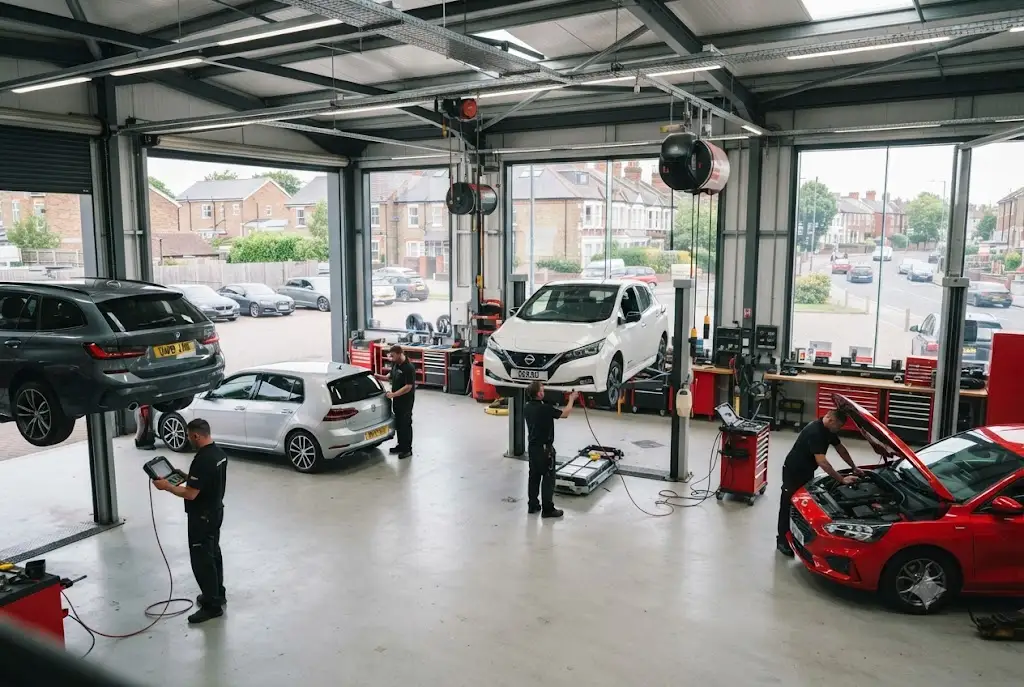
Garage chains have long had a powerful position in the UK automotive aftermarket. Familiar names, nationwide coverage, online booking and broad service menus make national networks an easy choice for motorists who want convenience. However, the market is changing quickly. Rising operating costs, evolving customer expectations, electric vehicles and stronger digital competition are forcing garage chains to rethink how they deliver value.
The question is no longer simply whether a large network can offer a service at scale. It is whether scale itself remains a meaningful advantage when motorists can compare prices online, choose independent garages through reviews and increasingly expect mobile or technology-led vehicle care.
Why Garage Chains Became So Important in the UK
The traditional advantage of garage chains is straightforward: reach. A motorist moving from one part of the UK to another can recognise a familiar brand and expect a broadly similar range of services. That familiarity can remove some of the uncertainty involved in choosing an unfamiliar workshop.
National networks can also spread purchasing, marketing, training, technology and administrative costs across many locations. A large organisation may have greater access to diagnostic equipment, parts supply agreements, booking systems and centralised customer support than a small workshop.
Convenience is another important factor. Many large operators combine MOT testing, servicing, tyres, brakes, batteries, diagnostics and other routine repairs. Some also offer mobile services, allowing customers to have selected work completed at home or at work.
That one-stop approach remains valuable, particularly for drivers who do not want to research several specialists for different maintenance jobs.
Garage Chains Face a More Competitive Market
Scale, however, does not automatically translate into customer loyalty. Motorists have more ways than ever to compare garages, read reviews and obtain quotes before committing to repairs.
Independent garages can compete on personal service, local reputation and flexibility. In many communities, a trusted mechanic may have relationships with customers that have developed over many years. Franchise garages can offer another middle ground, combining local ownership with access to a recognised brand, training and network support.
This means national garages increasingly have to compete on the complete customer experience rather than relying on brand recognition alone.
Price is also under scrutiny. When a customer can compare tyre prices, servicing packages and MOT availability online within minutes, a familiar logo is not enough to guarantee a booking.
What National Tyres & Autocare Shows About Scale
National Tyres & Autocare provides a useful example of how consolidation can create scale. The business is now part of the Halfords family and operates alongside the wider Halfords autocentre network. National says its technicians provide services including tyres, exhausts, brakes, batteries, MOT testing, safety inspections and servicing.
This type of network structure can create practical advantages for customers. A larger group can potentially offer wider coverage, shared systems and broader service capabilities while maintaining separate customer-facing brands.
It also shows why the future of garage chains may involve groups of complementary brands rather than one brand trying to provide every service from every site.
Kwik Fit Shows the Value of a Broad Service Network
Kwik Fit remains one of the clearest examples of a large UK automotive service network. Its current offering covers tyres, MOT testing, servicing, brakes, exhausts, batteries, air conditioning and other vehicle maintenance services. It also provides mobile tyre fitting.
The strength of this model is convenience. A customer searching for a tyre replacement may also need an MOT, brake inspection or service. Providing several services through one network creates opportunities to retain that customer beyond the original transaction.
However, breadth brings its own challenge. Every additional service requires appropriate equipment, technician skills, quality control and investment. As vehicles become more technologically advanced, garage chains must continually update their capabilities rather than simply expanding the number of services on a menu.
Halfords Is Moving Beyond the Traditional Garage Model
Halfords illustrates another important trend: combining physical garages with retail, online booking and mobile services.
Its current motoring proposition includes servicing, MOTs, repairs, tyre fitting, diagnostics, car checks and mobile fitting services. Halfords also promotes a network of more than 600 garages across its wider offering.
This hybrid model could become increasingly important. Customers may discover a service online, compare options, select a nearby workshop and then choose between visiting a garage or using a mobile service where available.
For garage chains, the workshop is therefore becoming only one part of the customer journey. Digital booking, communication, pricing, reviews and aftercare can be just as important as the physical repair itself.
Where Protyre and Other National Garages Fit In
Protyre, Fast Fit Autocentres and other national garages operate within a market where customers increasingly expect specialist knowledge alongside convenience.
Tyre-focused businesses have traditionally benefited from high customer awareness and frequent replacement demand. Yet the opportunity is expanding. Tyres connect directly with braking, suspension, steering, wheel alignment and vehicle safety, allowing businesses to build wider maintenance relationships.
At the same time, operators need to avoid treating every customer interaction as an opportunity for unnecessary upselling. Long-term trust is more valuable than a single high-value invoice. Clear explanations, transparent estimates and evidence of required work can help a garage turn a one-off visit into repeat business.
Fix Auto Highlights a Different Kind of Network
Fix Auto demonstrates that a network does not necessarily need to operate like a conventional fast-fit chain. Fix Auto UK is built around franchisee-owned and managed body repair centres, giving local businesses access to a recognised network while retaining local ownership.
That model is significant because it combines two things motorists increasingly value: local accountability and network-level support.
For some automotive businesses, this may prove more adaptable than a fully centralised structure. A local operator can maintain community relationships while the wider network provides training, processes, technology, brand recognition and commercial connections.
ATS Euromaster Is a Warning for Garage Chains
The changing economics of the sector are particularly visible in the case of ATS Euromaster. In 2026, the company began winding down its UK operations after previous restructuring and site closures failed to create a sustainable nationwide model. Its own UK website now states that its service centres are closed as part of the wind-down.
The development is important because it challenges the assumption that a large footprint is automatically an advantage. A nationwide network brings significant property, staffing, equipment and operating costs. If customer demand does not generate sufficient revenue at individual sites, a large network can become a liability rather than a competitive moat.
For the remaining garage chains, the lesson is not simply to open more locations. It is to make each location productive, relevant and capable of adapting to changing customer behaviour.
Why Independent Garages Remain a Serious Competitor
Independent garages have one advantage that large networks can find difficult to reproduce: local trust.
A good independent garage can build a reputation through recommendations, repeat customers and visible involvement in the local community. Customers may also appreciate speaking directly with the mechanic or workshop owner rather than dealing with a larger customer service structure.
That does not mean independent garages are automatically better than garage chains. Quality varies across both models. The important point is that national networks can no longer assume that their size alone will overcome the credibility of a well-regarded local competitor.
This is where customer reviews, transparent pricing and consistent workmanship become strategically important.
EVs Could Change the Competitive Balance
The transition towards electric vehicles adds another layer of complexity. EV servicing is not simply traditional servicing with a different powertrain. Workshops increasingly need appropriate diagnostic capabilities, technician training and procedures for high-voltage systems.
Garage chains with larger training budgets and central technical support may have an advantage when investing in these capabilities. However, independent workshops that specialise early in EVs can also build strong local expertise.
Drivers looking at long-term maintenance options will increasingly want to know whether a garage can work confidently on their particular vehicle. That makes specialist competence a potential differentiator alongside location and price.
For a deeper look at this shift, the wider cluster can explore EV servicing and the changing requirements of modern workshops.
Technology May Become the Real Advantage
The next competitive advantage for garage chains may not be the number of sites they operate. It may be the quality of the technology connecting those sites.
Online booking is already normal for many motorists. The next stage involves better diagnostics, digital vehicle records, automated customer updates, transparent estimates and more intelligent workshop scheduling.
Technology can also help large networks create a more consistent experience. If a customer’s service history, previous repairs and vehicle information are available across a network, moving between locations becomes easier.
For workshop operations, technology can improve capacity planning and reduce wasted appointment slots. For customers, it can mean fewer phone calls and clearer information about what their vehicle needs.
Customer Trust Will Decide the Winners
The strongest garage chains will ultimately be those that turn scale into genuine customer value.
That means competitive pricing matters, but so do accurate diagnostics, qualified technicians, convenient appointments, clear communication and reliable repairs. A large network can invest heavily in advertising, but advertising cannot permanently compensate for poor customer experiences.
Consumer protection also remains important. Government guidance makes clear that motorists remain responsible for ensuring their vehicles are safe to drive, while MOT results can identify major, dangerous, minor or advisory issues that require appropriate attention. Customers should therefore understand what work has been recommended and why.
For official information about MOT results and what happens after a test, motorists can consult GOV.UK guidance on MOT test results.
Will Garage Chains Keep Their Advantage?
Yes, but the advantage is likely to become more conditional.
Large garage chains still possess valuable assets: national recognition, purchasing power, training resources, digital infrastructure, broad service coverage and convenient locations. These factors are difficult for a single independent workshop to replicate.
However, scale can become a weakness when networks carry excessive operating costs or fail to adapt quickly enough. The ATS Euromaster wind-down is a powerful reminder that nationwide coverage has to be economically sustainable.
The most resilient garage chains are likely to combine the strengths of both large and small businesses. They will use network resources while delivering the transparency, expertise and personal service customers associate with the best independent garages.
That approach also creates opportunities to develop more specialist services, from EV diagnostics to modern wheel alignment technology and increasingly convenient tyre services.
The Future Is About Value, Not Just Size
Garage chains are unlikely to disappear from the UK automotive market. In fact, their scale can become even more valuable as vehicles become more complex and customers demand greater convenience.
But the definition of scale is changing. It is no longer enough to have hundreds of locations. A competitive network needs the right skills, technology, service consistency, digital experience and local relevance.
The future winners may therefore be the brands that make a large network feel surprisingly local while giving customers the technical capability and convenience of a national organisation.
In that environment, garage chains can keep their advantage. But they will have to earn it at every customer interaction.
