

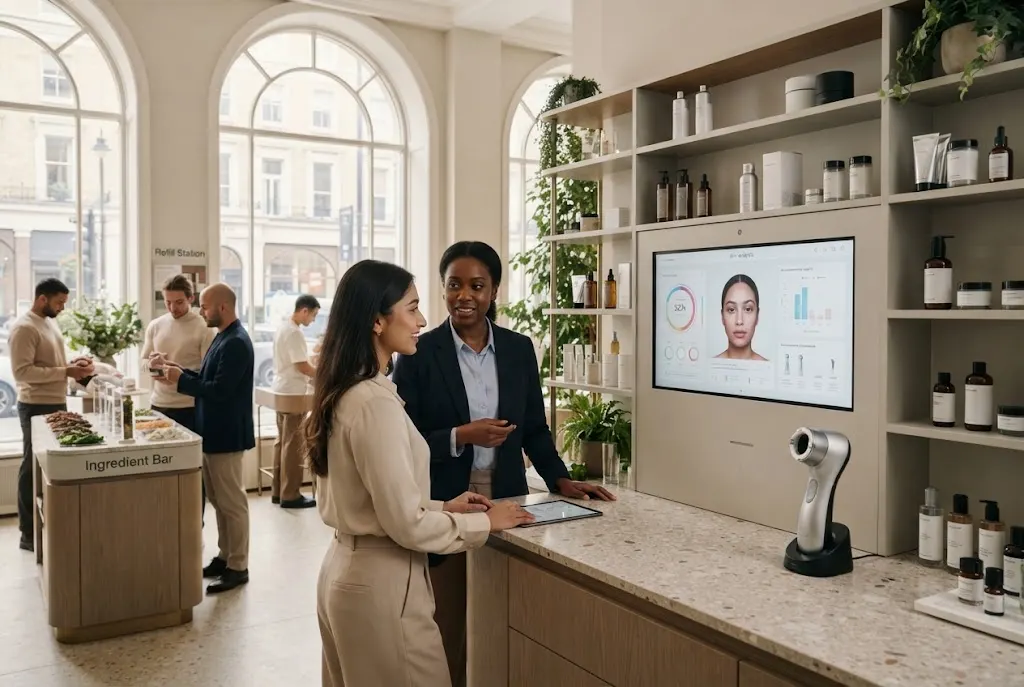
The future of beauty is unlikely to be defined by a single product, technology or trend. Instead, the next decade will be shaped by several forces moving at once: artificial intelligence, wellness, sustainability, ageing populations, changing ideas of authenticity, global cultural influence and consumers who increasingly expect beauty products to deliver measurable value.
Beauty is already moving beyond a simple focus on appearance. Skincare is becoming connected with wellness, technology is influencing product discovery, and consumers are moving between physical stores, social platforms and digital marketplaces with fewer boundaries. Recent industry research from McKinsey and NielsenIQ points to a market where shopping behaviour, technology and the definition of beauty itself are changing rapidly.
The important question is therefore not simply what the next beauty trend will be. It is how the relationship between consumers, brands, technology and personal identity will change over the next ten years.
The Future of Beauty Will Be More Personal
Personalisation has been discussed in beauty for years, but the next phase is likely to make it considerably more practical. Instead of recommending products based mainly on age, skin type or broad demographic categories, technology can help consumers make decisions around individual routines, preferences and concerns.
AI-powered tools are already being used to provide beauty recommendations, analyse skin and help consumers navigate increasingly large product catalogues. NielsenIQ reported in 2026 that more than half of consumers were exploring AI-enabled shopping tools, with 49% already receiving beauty recommendations from generative AI.
This does not mean human expertise will disappear. In many cases, technology will work alongside professionals, retailers and consumers rather than replacing them.
AI Will Change Beauty Discovery
AI beauty is likely to become one of the most influential developments of the coming decade. Consumers already use conversational AI to research ingredients, compare products and understand unfamiliar beauty concerns.
That changes how brands need to communicate. A product page designed only around traditional search keywords may not be enough when consumers increasingly ask conversational questions such as which ingredients suit a particular routine or which products address a specific concern.
McKinsey’s 2026 analysis suggests that AI shopping assistants could become increasingly important in ecommerce, helping consumers compare ingredients, efficacy claims and products suited to particular needs. The company also highlights the growing importance of structuring product information so AI systems can understand and recommend it.
For consumers, the potential benefit is convenience. For brands, however, AI creates a new challenge: being discoverable in an environment where recommendations may be generated rather than simply searched.
Beauty Technology Will Become Less Visible
Not every important innovation will look futuristic. Some of the most useful beauty technology may become integrated quietly into everyday routines.
Smart diagnostic tools, personalised recommendations, connected devices and increasingly sophisticated at-home treatments can reduce the gap between professional services and home routines. McKinsey identifies growing interest in at-home technologies including LED masks, radio-frequency tools and laser treatments.
The challenge will be separating genuinely useful technology from products that simply use technology as a marketing label.
Wellness Will Become Part of Beauty
One of the clearest changes in the beauty industry future is the continued overlap between beauty and wellness. Consumers increasingly view appearance as connected to sleep, stress, nutrition, mental wellbeing and broader self-care.
NielsenIQ reported that half of consumers surveyed considered regular self-care more important than five years earlier, while its 2025 research identified wellness and ritual as a major expansion area for beauty.
This creates a much wider definition of beauty. A nighttime skincare routine may sit alongside sleep rituals. Haircare can become part of self-care. Fragrance can be associated with mood and atmosphere rather than simply personal scent.
In the next decade, the most successful beauty brands may therefore compete not only on how a product changes appearance but also on how naturally it fits into a person’s wider lifestyle.
Sustainable Beauty Will Move From Trend to Expectation
Sustainability is another major force shaping the future of beauty. Consumers are becoming more aware of packaging, ingredients, sourcing, waste and the environmental impact of products.
However, sustainability is likely to become more complicated than simply using recyclable packaging. Consumers may increasingly ask whether a product genuinely reduces waste, whether its ingredients are responsibly sourced and whether its environmental claims are credible.
NielsenIQ’s research indicates that attributes including sustainable packaging, vegan products and cruelty-free positioning are gaining attention as consumers place greater importance on conscious purchasing.
This creates an opportunity for brands that can demonstrate meaningful improvements rather than relying on vague environmental language.
Transparency Will Matter More
The future of sustainable beauty will depend heavily on trust. Consumers have more access to information than ever before, and AI tools can make it easier to compare ingredients, claims and product descriptions.
That means brands will have fewer opportunities to hide behind complicated marketing language. Clear ingredient information, credible claims and straightforward explanations are likely to become increasingly valuable.
Ageing Will Be Reframed
Another important change will involve the way beauty approaches ageing. The traditional anti-ageing model has often presented ageing as something that must be hidden or reversed. A broader cultural shift is creating space for approaches focused on healthy ageing, skin quality, confidence and individual choice.
This does not mean consumers will stop buying products designed to address visible signs of ageing. Rather, the language surrounding those products may change.
The future beauty trends associated with ageing are likely to include prevention, skin health, personalised routines and products designed around different stages of life rather than a single ideal of youth.
This could also create more meaningful opportunities for older consumers who have historically been underrepresented in beauty marketing.
Authenticity Will Become More Valuable
Beauty consumers are surrounded by edited images, filters, influencer marketing and highly produced advertising. As synthetic content and AI-generated imagery become easier to create, genuine human experiences may become more valuable rather than less.
Authenticity does not mean that brands must abandon polished campaigns. It means consumers may increasingly want to know who is behind a product, why it exists, what it actually does and whether the claims can be trusted.
Real customer experiences, transparent product demonstrations and credible expertise may therefore become stronger competitive advantages.
Global Beauty Trends Will Influence Local Markets
The next decade will also be more globally connected. Consumers can discover Japanese skincare, Korean cosmetics, African haircare practices, Middle Eastern fragrance traditions and emerging brands from almost anywhere through social platforms and ecommerce.
This creates a more fluid beauty culture. Trends no longer have to travel slowly from one major fashion capital to another. A product can become visible to millions of consumers through creators, communities and social commerce.
NielsenIQ has highlighted the growing importance of digital beauty discovery and social commerce, while McKinsey notes that consumers are increasingly moving across categories, channels and price tiers.
The result could be a beauty market where cultural influence is increasingly distributed rather than controlled by a small number of traditional centres.
Beauty Startups Will Challenge Established Brands
Beauty startups have an important role to play in the industry’s next decade because smaller companies can often experiment faster than established organisations.
Startups may focus on specific consumer communities, unusual ingredients, technology-enabled experiences, sustainable packaging or highly specialised products. Their advantage is not necessarily scale. It can be relevance.
At the same time, established beauty companies have significant advantages in research, manufacturing, distribution and brand recognition. The competition between agile newcomers and established players could therefore accelerate innovation across the entire sector.
Consumers Will Demand More Evidence of Efficacy
One of the biggest changes may be the growing importance of beauty consumer trends around efficacy. Consumers are increasingly exposed to product claims and have more tools for researching whether those claims make sense.
This could push the industry toward clearer explanations of ingredients, formulation, testing and expected results.
It may also change how products are marketed. Instead of relying primarily on aspirational language, brands could increasingly explain what a product is designed to do, how it should be used and what consumers can realistically expect.
That shift connects directly with the changing concept of beauty value. A product that costs more may still be attractive if consumers believe its performance, formulation and relevance justify the price.
The Beauty Consumer Will Become More Selective
The next decade is unlikely to be about simply buying more beauty products. Consumers may increasingly want fewer products that perform multiple functions or fit more naturally into their routines.
Economic pressure is one factor, but so is information overload. When shoppers have thousands of products to choose from, simplicity can become valuable.
McKinsey’s latest beauty analysis points to increasingly fluid consumer behaviour across price tiers and categories, including selective trading down in Europe as consumers become more price sensitive.
This does not mean premium beauty will disappear. Instead, the market may become more polarised, with consumers willing to spend more on products they consider genuinely worthwhile while looking for savings elsewhere.
Retail Will Blend Physical and Digital Experiences
The future of beauty retail will not necessarily be online versus offline. It will increasingly be both.
Consumers may discover a product through social media, research it through an AI assistant, inspect it in a physical store and then purchase it through an app. Another consumer might do the reverse.
NielsenIQ has reported that online beauty sales have been growing substantially faster than in-store sales, while also stressing that physical retail remains important.
This means physical beauty stores will need to offer experiences that complement digital convenience. Specialist advice, product discovery, demonstrations and personalised service can all provide reasons to visit a physical retailer.
Our guide to hair and cosmetics shops explores the role specialist retailers continue to play in this changing environment.
Beauty Will Become More Inclusive
Inclusivity is likely to move beyond simply expanding shade ranges. The broader beauty market is becoming more aware that consumers have different hair textures, skin characteristics, ages, cultural backgrounds, lifestyles and definitions of attractiveness.
That creates opportunities for brands to develop products around specific needs instead of treating diversity as a marketing campaign.
Specialist retailers already demonstrate why this matters. A dedicated store serving particular hair and beauty needs can provide products that may be difficult to find in general retail environments.
What Will Matter Most in the Next Decade?
There will undoubtedly be trends that disappear as quickly as they arrive. But several structural changes are more likely to have lasting influence.
- AI will change product discovery and personalisation.
- Technology will become increasingly integrated into beauty routines.
- Wellness will continue to expand the definition of beauty.
- Sustainability and transparency will influence purchasing decisions.
- Ageing will increasingly be approached through health, confidence and individuality.
- Global cultural influences will move faster through digital platforms.
- Consumers will demand stronger evidence of product efficacy.
- Beauty retail will blend physical experiences with digital convenience.
- Smaller brands and startups will continue challenging established players.
- Authenticity and trust will become increasingly important in a highly synthetic digital environment.
What the Future of Beauty Means for Consumers
For consumers, the changing industry should ultimately mean more choice. But more choice also creates responsibility. The ability to discover thousands of products does not automatically make it easier to identify the right one.
Consumers will need to become better at evaluating ingredients, product claims, reviews and recommendations. AI can help with this process, but it should be treated as a tool rather than an unquestionable authority.
Personal preference will also remain central. The future of beauty is not about finding one perfect routine for everyone. It is about giving individuals better information and more relevant options.
What the Future of Beauty Means for Brands
For beauty companies, the next decade will reward adaptability. Brands will need to understand not only what consumers buy but why they buy it, how they discover products and what values influence their decisions.
Innovation will remain important, but innovation without trust may struggle. A technologically advanced product still needs to solve a genuine consumer problem. A sustainable claim still needs evidence. A personalised recommendation still needs to feel useful rather than intrusive.
The strongest brands are likely to connect innovation with relevance: technology that makes life easier, products that perform well, communication that feels credible and experiences that respect the consumer.
Final Thoughts
The future of beauty will be shaped by much more than new shades, formulas and seasonal trends. Technology, wellness, sustainability, ageing, globalisation and changing consumer expectations are already redefining what beauty means and how people experience it.
AI may transform discovery. Wellness may broaden the category. Sustainability may raise expectations around transparency. Global culture may continue breaking down traditional beauty boundaries. At the same time, consumers may become more selective about what deserves their attention and money.
The most interesting part of the next decade is therefore not knowing exactly which trend will dominate. It is watching how these forces interact.
Beauty has always reflected the culture around it. As technology changes how people live, shop and communicate, beauty will change with them. The brands and retailers most prepared for the next decade will be those that understand this wider transformation rather than chasing every short-lived trend.
