

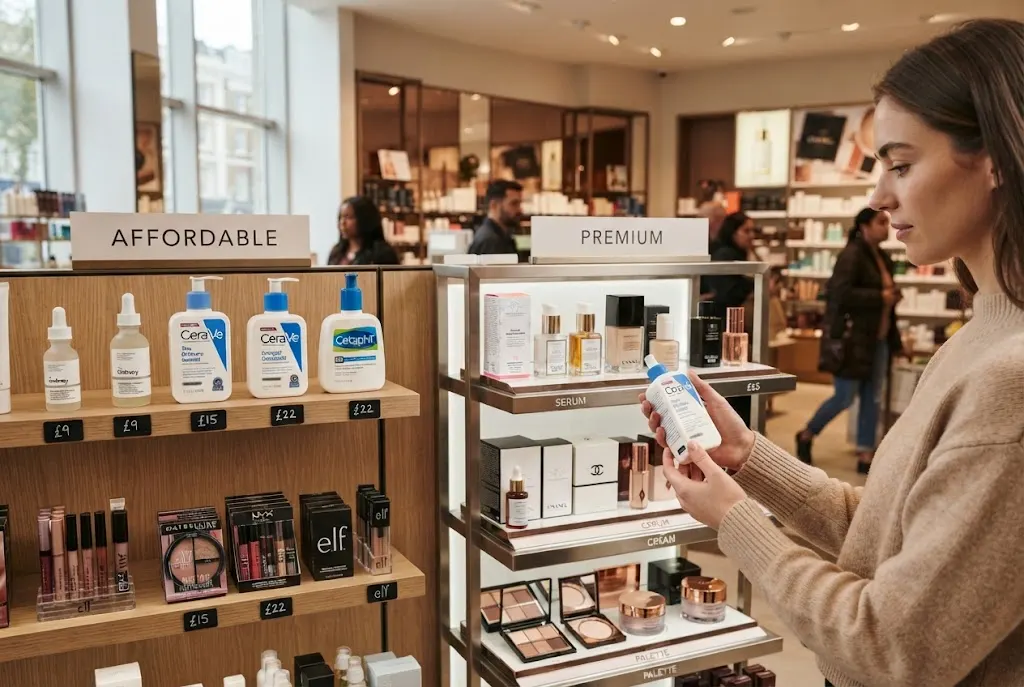
Beauty value is changing. For years, value in cosmetics and personal care was often associated with getting a product for the lowest possible price. Today, consumers are increasingly asking a different question: does this product deliver enough quality, efficacy, relevance and experience to justify what I am paying?
That shift is creating a more complicated beauty market. Some shoppers are actively looking for affordable products and discounts, while others continue to spend on premium and luxury products that they believe deliver distinctive benefits. At the same time, technology, wellness, sustainability and changing consumer expectations are influencing what people consider worth buying.
Recent industry research from NielsenIQ and McKinsey points to a beauty market where consumers are becoming more selective and where value is increasingly connected with product performance, personal relevance and the overall purchasing experience.
What Does Beauty Value Really Mean?
Beauty value is not simply the difference between a product’s price and its size. It is the broader relationship between what a consumer pays and what they believe they receive in return.
That can include several factors:
- How effectively the product performs.
- Whether it solves a genuine personal need.
- How long the product lasts.
- Whether the formulation feels appropriate for the consumer.
- How convenient it is to purchase and use.
- Whether the brand’s values align with the shopper.
- Whether technology or innovation genuinely improves the experience.
This broader definition explains why two consumers can look at exactly the same product and reach completely different conclusions about whether it offers good value.
Beauty Value Is Not the Same as Cheap Beauty
One of the most important changes in beauty shopping is the separation between low price and good value.
A budget product can provide excellent value if it performs well and fits naturally into a consumer’s routine. However, a cheap product that does not work may represent poor value even when its initial price is low.
The opposite is also true. A premium product can be considered good value by someone who believes its performance, formulation, durability or experience justifies the higher cost.
As a result, the beauty market is not simply moving towards cheaper products. It is becoming more focused on whether the purchase feels worthwhile.
Affordable Beauty Is Becoming More Sophisticated
Affordable beauty has expanded far beyond basic low-cost cosmetics. Consumers can now find budget-friendly products across skincare, makeup, haircare and personal care, including products positioned around specific ingredients, concerns and beauty routines.
This has raised expectations. A lower price no longer automatically gives a product an advantage if shoppers believe another affordable alternative performs better.
Social media has also accelerated this comparison process. Consumers can see product demonstrations, reviews, comparisons and recommendations before making a purchase. Consequently, brands competing in the affordable segment need to communicate what makes their products useful rather than relying solely on a low price.
Why Premium Beauty Still Has Strong Appeal
The growth of affordable beauty does not mean premium beauty is disappearing. Consumers continue to spend more when they perceive meaningful differences in quality, formulation, performance or experience.
Premium products can also benefit from strong brand identity. Packaging, sensory experience, reputation, research and perceived expertise can all influence how consumers evaluate a product.
However, premium positioning creates higher expectations. The more consumers pay, the more likely they are to ask whether the product actually delivers something that cheaper alternatives cannot.
This creates an important distinction between premium pricing and premium value. A higher price by itself does not guarantee that consumers will perceive a product as worthwhile.
Luxury Beauty Depends on Meaning as Well as Performance
Luxury beauty operates at an even more complex level. Consumers may purchase luxury cosmetics and skincare because of formulation and performance, but emotional and symbolic factors can also influence the decision.
Brand heritage, design, exclusivity, packaging, retail experience and personal identity can all contribute to perceived value.
For some shoppers, those elements are an important part of the product. For others, they are less meaningful than efficacy. Neither perspective is necessarily wrong because value is ultimately connected to individual priorities.
The challenge for luxury beauty brands is therefore to ensure that the premium experience remains relevant in a market where consumers can compare alternatives more easily than ever.
Beauty Discounts Can Attract Shoppers, But They Do Not Guarantee Value
Beauty discounts are an effective way to attract attention, particularly when consumers are trying to manage spending. Sales, promotions and outlet shopping can make premium products more accessible and encourage shoppers to experiment with unfamiliar brands.
However, a discount can also create unnecessary spending. Buying a product simply because its price has been reduced does not necessarily represent good value if it does not fit your routine.
Before purchasing a discounted beauty product, consider whether you would have wanted it without the promotion. If the answer is no, the saving may not actually represent a useful purchase.
Budget Makeup UK Shoppers Have More Choice
The budget makeup UK market illustrates how consumer expectations have changed. Affordable cosmetics are increasingly available across high-street retailers, specialist stores and online marketplaces.
Consumers can compare finishes, ingredients, shades and reviews without necessarily moving into premium price brackets.
This competition benefits shoppers because brands have stronger incentives to improve formulas and communicate product benefits. Yet it also makes the market more crowded, meaning consumers need clearer criteria for deciding what deserves their money.
Product Efficacy Is Becoming Central to Beauty Value
Beauty product efficacy is one of the strongest ways a brand can demonstrate value. Consumers want to know whether a product actually does what it claims to do.
This is particularly important for skincare, where shoppers may invest in products containing active ingredients or specialised formulations. Claims about hydration, brightening, smoothing or other benefits need to be considered alongside the product’s intended use and realistic expectations.
For makeup and haircare, efficacy can mean something different. It may involve coverage, wear time, ease of styling, manageability or compatibility with an individual’s routine.
In every category, however, the basic question remains the same: does the product perform well enough to justify its place in the consumer’s routine?
Beauty Quality Matters More When Consumers Buy Less
When consumers become more selective about spending, beauty quality can become more important. A shopper who is purchasing fewer products may spend more time comparing options before committing.
This can benefit brands that focus on durable, effective and clearly differentiated products. It can also pressure brands with weak product performance because consumers have more opportunities to compare alternatives.
Quality does not necessarily mean expensive ingredients or luxury packaging. It means that the product performs consistently and meets the expectations created by the brand.
Beauty Consumer Spending Is Becoming More Polarised
Beauty consumer spending is increasingly difficult to describe using one simple trend. Consumers can be highly price conscious in one category while spending significantly more in another.
Someone might choose affordable shampoo while investing in a premium skincare treatment. Another shopper might buy luxury fragrance but use budget makeup.
This behaviour means beauty brands need to understand the reason behind each purchase rather than assuming consumers belong permanently to a budget, premium or luxury segment.
McKinsey has described beauty as a market where consumers increasingly move between price tiers, including selective trading down in response to economic pressure.
Technology Is Changing How Consumers Judge Value
Technology is becoming part of the value equation. Consumers can use digital tools to research ingredients, compare products, discover alternatives and receive personalised recommendations.
AI-powered shopping tools may make this process even easier. Instead of manually comparing dozens of product pages, shoppers can ask increasingly specific questions about products and routines.
This connects with the wider future of beauty, where AI, personalisation and digital discovery are expected to influence how consumers find and evaluate products.
Technology can therefore increase competition. If consumers can quickly discover alternatives, brands must give them convincing reasons to choose one product over another.
Personal Relevance Is Part of Value
A product can be high quality and still offer poor value to the wrong consumer.
For example, a complex skincare product may be unnecessary for someone with a simple routine. An expensive foundation may not be worthwhile for someone who rarely wears makeup. A specialised hair product may be highly valuable to one consumer and irrelevant to another.
This is why relevance matters. Consumers increasingly want products that fit their actual lifestyle, preferences and needs rather than simply following every beauty trend.
Wellness Is Expanding the Meaning of Value
Beauty and wellness are becoming increasingly connected. Consumers may value a product not only for its visible result but also for the experience it creates within a wider self-care routine.
Fragrance, skincare, bath products and haircare can all become part of personal rituals. In these cases, value may involve sensory experience, relaxation and enjoyment as well as functional performance.
This does not mean wellness claims should automatically justify a higher price. Consumers are likely to become more interested in whether the experience genuinely adds something meaningful to their routines.
Sustainability Can Influence Perceived Beauty Value
Sustainability is another factor that can influence purchasing decisions. Some consumers consider packaging, sourcing, formulation and environmental impact when evaluating whether a product is worth buying.
However, sustainable positioning must be credible. Consumers increasingly have access to information that allows them to investigate environmental claims, and vague messaging can weaken trust.
A product that uses more responsible materials may carry additional value for a consumer who prioritises sustainability. Another consumer may place greater importance on price or efficacy. Again, perceived value depends on individual priorities.
Why Meaning Matters More Than Ever
Modern beauty consumers are not always buying products simply to improve their appearance. Beauty can also express identity, culture, confidence, creativity and personal lifestyle.
This makes meaning an increasingly important component of value. A product may resonate because it represents a particular community, supports a personal philosophy or fits an individual’s idea of beauty.
Brands that understand this can build stronger relationships with consumers. But the connection needs to feel genuine. Marketing a superficial idea of purpose without delivering meaningful substance can have the opposite effect.
How Beauty Retailers Can Communicate Value
Retailers have an important role in helping consumers understand value. Clear product information, useful comparisons and knowledgeable staff can make purchasing decisions easier.
Specialist stores can be particularly valuable because they may provide a focused selection rather than overwhelming shoppers with thousands of unrelated products. Our guide to hair and cosmetics shops explores how specialist retailers can help customers find products suited to specific needs.
Online retailers can also communicate value through detailed product pages, ingredient information, customer reviews and practical usage guidance.
Consumers Are Learning to Look Beyond the Price Tag
The modern beauty shopper has more information than previous generations. Product reviews, ingredient databases, tutorials, comparisons and social content can all influence purchasing decisions.
As a result, the simple message of “cheaper is better” has become less convincing.
Consumers can ask whether a product lasts long enough, performs consistently, fits their routine, uses ingredients they are comfortable with and provides an experience they genuinely appreciate.
This makes beauty value multidimensional rather than purely financial.
What Beauty Brands Need to Understand
The changing definition of value creates opportunities across every price segment.
Affordable brands need to prove that lower prices do not require unnecessary compromises in performance. Premium brands need to demonstrate why their products justify additional spending. Luxury brands need to deliver meaning and experience alongside quality.
Across all three segments, transparency will become increasingly important.
Consumers are unlikely to accept higher prices simply because a product is marketed as premium. They will increasingly want to understand what makes it different.
The Future of Beauty Value
The next stage of the beauty market will likely make value even more personal. Technology will give consumers more information, AI will make product discovery more conversational, and global ecommerce will continue expanding the number of alternatives available.
At the same time, economic conditions can change how consumers allocate their budgets. Someone may trade down temporarily without abandoning premium beauty altogether. Another consumer may become more willing to invest in products that solve a specific problem.
That flexibility means beauty brands will need to earn value repeatedly rather than assume loyalty will last forever.
How Consumers Can Get Better Beauty Value
Consumers do not need to avoid premium products or buy only the cheapest options. Instead, a more useful strategy is to evaluate each purchase according to personal priorities.
- Identify the problem you want the product to solve.
- Compare similar products across different price levels.
- Read the ingredients and directions.
- Look for credible information about product performance.
- Consider how frequently you will use the product.
- Think about whether the product fits your existing routine.
- Do not confuse a discount with genuine value.
- Spend more when the additional benefit is meaningful to you.
Final Thoughts
Beauty value is becoming much more nuanced than simply finding the lowest price. Consumers are increasingly judging purchases according to efficacy, quality, relevance, experience, technology, sustainability and personal meaning.
That does not spell the end of affordable beauty, premium beauty or luxury beauty. Instead, it creates a market where every price segment must demonstrate why its products deserve consumer attention and spending.
The strongest definition of value may therefore be simple: getting something genuinely useful, enjoyable or meaningful in return for what you spend.
As the future of beauty develops, that principle is likely to become even more important. Consumers will have more choices, more information and more ways to compare products. Brands that understand what their customers genuinely value will be better positioned to earn their trust and keep their place in increasingly competitive beauty routines.
