

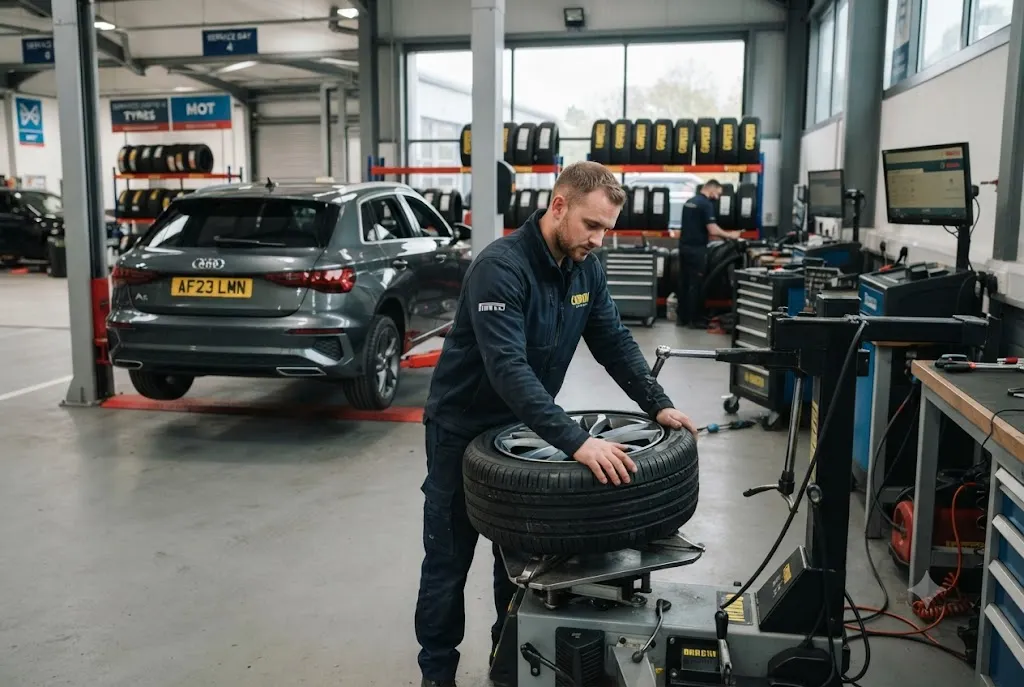
Tyre services are becoming more advanced as UK motorists expect greater convenience, better safety information and faster access to vehicle maintenance. Traditional tyre fitting and replacement remain essential, but the sector is increasingly moving towards mobile fitting, digital monitoring, vehicle-specific tyre technology and predictive maintenance.
Tyres remain one of the most important safety components on any vehicle because they provide the contact between the car and the road. That makes correct fitting, inflation, condition and tread particularly important. At the same time, electric vehicles and connected-car technology are creating new requirements for workshops and tyre specialists.
The future of tyre services is therefore unlikely to be defined by simply selling and fitting tyres. Instead, successful providers will increasingly combine convenience, diagnostics, safety expertise and technology.
Why Tyre Services Matter More Than Ever
Tyre maintenance is sometimes treated as a routine expense, but tyre condition can influence braking, steering, handling, comfort and vehicle efficiency.
UK motorists are legally responsible for ensuring that their vehicles are roadworthy. GOV.UK states that car tyres must have at least 1.6mm of tread across the central three-quarters of the tyre and around its entire circumference. Tyres must also be correctly inflated and free from relevant cuts and defects.
However, the legal minimum should not be confused with an ideal maintenance target. Drivers should regularly inspect their tyres and follow the vehicle manufacturer’s recommendations for pressure, load and tyre specification.
That creates a continuing role for professional tyre services. A trained fitter can identify damage, abnormal wear, incorrect fitment and other issues that may not be obvious to an inexperienced driver.
Tyre Fitting Is Becoming More Convenient
Traditional tyre fitting requires the customer to take the vehicle to a workshop, wait for the work to be completed and then return home or continue the journey.
Mobile tyre fitting changes that model by bringing selected services to the customer’s location. Depending on the provider and circumstances, tyres can be fitted at a home address, workplace or another suitable location.
The appeal is straightforward: convenience.
For busy motorists, avoiding a workshop visit can save considerable time. It can also be useful when a vehicle has suffered a tyre problem and travelling to a garage may be inconvenient or inappropriate.
Mobile services do not replace conventional workshops completely, however. Some jobs require specialist equipment or additional inspection, and customers should understand exactly what a mobile appointment includes before booking.
The Growth of Mobile Tyre Fitting
Mobile tyre fitting is likely to remain an important part of the UK’s tyre market because it aligns with a wider shift towards services delivered at the customer’s location.
The model can work particularly well for straightforward tyre replacement where the vehicle is safely accessible and the required tyre is available.
It also creates an interesting competitive opportunity for both independent operators and larger garage chains. Large networks can use established booking systems and purchasing power, while smaller mobile specialists can compete through flexibility and local responsiveness.
Customers should still check whether the provider can perform any additional work that might be required. For example, a tyre replacement may reveal alignment, suspension or wheel-related issues that require workshop equipment.
Tyre Replacement Is Not Always the Same as Tyre Repair
When a tyre loses pressure or becomes damaged, replacement is not automatically the only possible solution.
Whether a tyre can be repaired depends on the nature and location of the damage, the tyre’s condition and applicable industry and safety requirements. A professional inspection is therefore important before deciding between repair and replacement.
Drivers should be cautious about continuing to use a damaged or significantly deflated tyre simply because it appears to be holding some air. Internal damage may not always be obvious from the outside.
A reputable tyre service should explain the available options and identify when replacement is necessary rather than treating every problem as an automatic tyre sale.
Tyre Balancing Remains an Important Service
Tyre balancing is another established service that will remain relevant even as tyre technology develops.
When a wheel and tyre assembly is not correctly balanced, drivers may experience vibration, particularly at certain speeds. A professional balancing machine can identify weight differences and help the technician correct the imbalance.
Balancing should not be confused with wheel alignment. Alignment concerns the geometric positioning of the wheels, while balancing concerns the distribution of weight around the rotating wheel and tyre assembly.
The two services can sometimes be discussed together because tyre wear, steering behaviour and vibration may have overlapping symptoms. However, the correct service should be determined through diagnosis rather than assumption.
Tyre Safety Should Be at the Centre of the Customer Experience
Technology and convenience are valuable, but safety remains the core purpose of professional tyre services.
GOV.UK advises drivers to check tyre pressure and condition and states that tyres must meet the applicable legal tread requirements. The Highway Code also says tyres must be inflated to the vehicle manufacturer’s specification for the load being carried.
Drivers should pay attention to more than tread depth. Cuts, bulges, cracks, abnormal wear and incorrect inflation can all indicate a problem requiring investigation.
Tyre pressure is particularly important because the correct setting can vary according to the vehicle and load. The appropriate information is usually available in the vehicle handbook or on the manufacturer’s specified information label.
Smart Tyres Could Change the Industry
One of the most interesting developments in tyre technology is the emergence of increasingly connected tyre-monitoring systems.
Modern vehicles already use tyre-pressure monitoring systems on many models. These systems can alert drivers when pressure changes significantly, helping them identify potential problems earlier.
Future smart-tyre technology could go further by providing more information about tyre condition, temperature, pressure and usage. The more useful data becomes available, the greater the potential for maintenance decisions to become proactive rather than reactive.
However, connected technology should complement physical inspection rather than replace it. A sensor can report information about pressure or another measurable characteristic, but technicians still need to assess visible tyre damage and other physical conditions.
Predictive Tyre Maintenance Could Reduce Unexpected Problems
Predictive maintenance represents a broader shift from waiting for a component to fail towards identifying potential problems earlier.
In tyre services, predictive approaches could use information such as pressure, mileage, temperature, wear patterns and driving conditions to estimate when a tyre may need attention.
Research into predictive tyre-health systems is already exploring machine-learning models that use historical and real-time information to estimate tyre condition and support replacement decisions.
This does not mean that every UK driver will immediately have an artificial-intelligence system predicting tyre replacement dates. The practical rollout will depend on vehicle technology, sensor availability, data quality and cost.
Nevertheless, the direction is significant. If tyre condition can be monitored more intelligently, workshops could eventually contact drivers before a developing issue becomes an emergency.
Electric Vehicles Are Changing Tyre Requirements
The growth of electric vehicles is another major factor shaping tyre services.
EVs can have different weight characteristics and power delivery compared with conventional cars. Manufacturers may therefore specify tyres designed around the particular requirements of an electric model.
For tyre specialists, this means understanding more than tyre dimensions. Load ratings, efficiency considerations, noise characteristics and vehicle-specific requirements can all influence the appropriate tyre choice.
This connects closely with the wider EV servicing cluster. As electric vehicles become more common, workshops need to understand how tyres fit into the broader maintenance needs of these vehicles.
Why Correct Tyre Selection Matters
Choosing a replacement tyre involves more than finding a product that physically fits the wheel.
Drivers should consider the vehicle manufacturer’s requirements, tyre size, load and speed ratings and the conditions in which the vehicle is normally driven.
Using the wrong specification can affect vehicle performance and may create safety or compliance concerns. A professional tyre provider should therefore confirm the appropriate specification before fitting a replacement.
This becomes particularly important when replacing only one or two tyres. Depending on the vehicle and drivetrain, differences between tyres can have implications for handling and system operation.
Drivers should follow manufacturer guidance and ask a qualified tyre professional when they are unsure.
Tyre Services and Wheel Alignment Work Together
Tyre replacement can sometimes reveal problems that are not immediately obvious.
For example, if one tyre has worn significantly faster than another, a technician may investigate wheel alignment, suspension condition, tyre pressure history or another contributing factor.
This is why tyre services and alignment should be viewed as connected areas rather than isolated products. A new tyre may restore the vehicle temporarily, but identifying the reason for abnormal wear can help prevent the same problem from returning.
Our guide to wheel alignment explores how digital alignment technology is helping UK workshops measure vehicle geometry more accurately.
What Customers Should Expect From Professional Tyre Services
A professional tyre appointment should be more than simply removing an old tyre and fitting a new one.
Customers should expect the technician to confirm the correct tyre specification and inspect the relevant wheel and tyre condition. Where appropriate, the technician may also identify issues such as abnormal wear, pressure problems, valve concerns or visible damage.
Good communication matters as well. If additional work is recommended, customers should be told what has been identified and why the work is relevant.
This approach reflects the broader principles discussed in our article about automotive service companies. Trust is built when businesses combine technical competence with clear explanations and transparent recommendations.
Technology Will Not Replace Skilled Tyre Technicians
Connected systems, digital tyre machines and predictive analytics can improve the service experience, but skilled technicians will remain essential.
Tyres are physical components. They can suffer damage from potholes, kerbs, road debris, incorrect inflation and wear. Not every problem can be identified through a digital sensor.
A technician also needs to understand when the available data does not tell the whole story. If a vehicle shows abnormal wear, the correct response may involve inspecting alignment or suspension rather than simply replacing the tyre.
The future of tyre services is therefore likely to combine technology with human judgement rather than choosing one over the other.
How Tyre Services Could Become More Proactive
Traditional tyre maintenance is largely reactive. A driver notices low tread, a puncture or vibration and then books an appointment.
The next generation of services could become more proactive.
A connected vehicle might identify changing pressure or temperature patterns. A workshop could combine that information with mileage and previous service records. The customer could then receive a maintenance recommendation before the tyre reaches a critical condition.
This model could make tyre maintenance more predictable and potentially reduce inconvenient roadside failures.
It could also help tyre businesses develop longer-term relationships with customers instead of relying entirely on replacement transactions.
What UK Drivers Can Check Themselves
Professional tyre services are important, but motorists can perform simple checks between appointments.
- Check tyre pressures according to the vehicle manufacturer’s recommendations.
- Look for visible cuts, cracks, bulges or other damage.
- Check tread depth regularly.
- Look for unusual or uneven wear.
- Pay attention to warning lights related to tyre pressure.
- Check the spare wheel or tyre repair equipment where fitted.
- Inspect tyres before long journeys.
GOV.UK recommends checking that tyres have the correct tread depth and are free from cuts and defects. Its current vehicle-safety guidance also reminds motorists that a valid MOT does not necessarily mean a vehicle remains safe to drive between tests.
If a tyre appears damaged or unsafe, motorists should seek professional advice rather than continuing to drive unnecessarily.
Will Mobile and Smart Tyre Services Replace Traditional Workshops?
Probably not. Instead, the market is likely to become more varied.
Mobile tyre fitting can provide convenience for straightforward jobs. Traditional workshops remain important for more comprehensive inspections, balancing, alignment and repairs requiring additional equipment. Specialist tyre centres can provide product knowledge and technical expertise.
Large garage networks can combine these services with extensive coverage, while independent operators can compete through local relationships and flexibility.
The customer may therefore have more choices rather than fewer.
The Future of Tyre Services in the UK
The future of tyre services will be shaped by three major trends: convenience, connectivity and safety.
Mobile fitting can make tyre replacement easier. Smart technology can provide more information about tyre condition. Predictive maintenance could eventually help identify problems before they become urgent.
At the same time, the fundamentals will not disappear. Tyres will still need the correct specification, inflation, tread and physical condition. They will still need to be fitted correctly, and vehicles will still require professional attention when problems arise.
For businesses, the opportunity is to combine traditional technical expertise with modern service delivery. For motorists, the benefit could be a tyre service experience that is faster, more transparent and increasingly proactive.
Final Thoughts
Tyre services are evolving from a straightforward replacement business into a broader part of connected vehicle maintenance. Mobile tyre fitting is improving convenience, digital equipment is supporting more accurate workshop processes and smart-tyre technology could eventually make maintenance increasingly predictive.
Yet the most important priority remains tyre safety. Technology can provide useful information, but motorists still need appropriate tyres, correct pressures, sufficient tread and regular inspection.
The strongest tyre providers will be those that combine these fundamentals with better customer service and smarter technology. As UK vehicles become increasingly connected and electric, tyre maintenance will remain essential while the way that service is delivered continues to change.
