

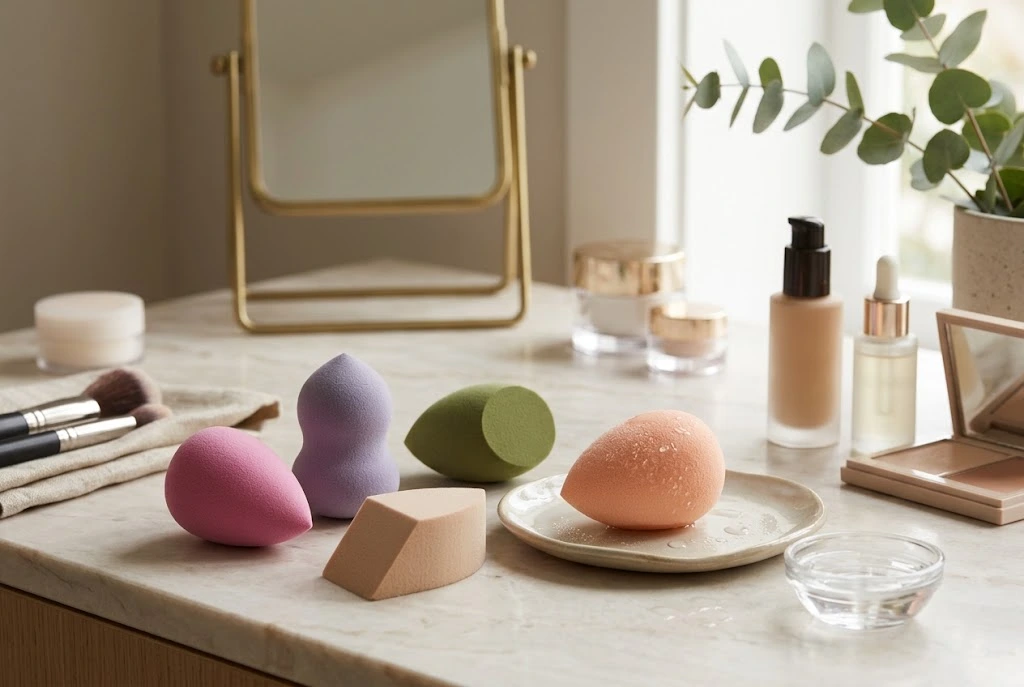
A beauty blender can transform the way foundation and other complexion products are applied, but it is not the only type of makeup sponge available. Walk into any beauty shop and you will find different shapes, sizes, textures and prices, making it difficult to know whether a branded beauty blender is actually better than a standard makeup sponge.
The answer depends on what you want from your makeup application. Some sponges are designed for seamless foundation, others are better for concealer or contouring, while different shapes can make certain areas of the face easier to reach. This guide compares beauty blenders and makeup sponges, explains how they differ and helps you choose the most suitable option for your routine.
What Is a Beauty Blender?
A beauty blender is a soft cosmetic sponge designed to help apply and blend liquid, cream and some powder makeup products. The term is commonly associated with the original teardrop-shaped Beautyblender, although people often use “beauty blender” more generally when referring to makeup sponges.
The rounded base can be useful for applying foundation across larger areas of the face, while the narrower end helps reach areas such as around the nose and underneath the eyes.
One of the main reasons these sponges are popular is their ability to create a blended complexion without obvious edges. When used correctly, the sponge can help distribute product gradually rather than leaving a heavy layer in one area.
Beauty Blender vs Makeup Sponge: What’s the Difference?
The biggest difference is often branding, construction and material rather than the basic purpose. A branded beauty blender is a particular product, while “makeup sponge” describes a much broader category of cosmetic applicators.
Makeup sponges can come in teardrop, wedge, oval, flat-edge and multi-sided designs. Some are designed to be used damp, while others are intended for dry application. Their texture can also vary from very soft and flexible to firmer and more compact.
Therefore, comparing one beauty blender with one generic sponge is not always enough. A high-quality makeup sponge can perform very well, while a poorly designed sponge may absorb too much product or feel uncomfortable against the skin.
How a Beauty Blender Applies Foundation
For liquid foundation, a beauty blender is usually used by gently pressing and bouncing the sponge across the skin rather than dragging it. This technique can help build coverage gradually and blend the product into the complexion.
Using the sponge damp can change the application experience. A properly prepared sponge becomes softer and more flexible, which can make blending easier. It can also help prevent the applicator from feeling overly dry against the skin.
However, the sponge should not be soaking wet. Excess water should be squeezed out before application so that the makeup is not unnecessarily diluted.
For Natural-Looking Coverage
A damp sponge can be useful when you want a lighter, more diffused foundation finish. Instead of placing a thick layer of product on the face, you can build coverage gradually in areas where you need it.
For Buildable Coverage
The same technique can also work for fuller coverage. Apply a small amount of additional product to areas that need more coverage and gently press it into the skin.
This controlled approach can be particularly useful when working with complexion products that become heavy if too much is applied at once.
Is a Beauty Sponge Better Than a Makeup Sponge?
There is no universal winner. A quality beauty sponge can produce an excellent finish without being the most expensive option available.
The ideal sponge depends on its texture, shape and intended use. A very soft sponge may be excellent for blending foundation, while a firmer sponge with a flat edge could be more useful for precise application.
Instead of focusing entirely on the brand name, consider how the sponge feels, how much product it absorbs and whether its shape suits the products you use.
Beauty Blender Shapes and Sizes
Shape matters because different parts of the sponge perform different jobs. The classic rounded design is versatile, but other shapes can offer useful alternatives.
Teardrop Beauty Blender
A teardrop-shaped applicator is one of the most versatile designs. The broad rounded base can cover larger areas, while the pointed end can reach smaller spaces.
This makes it suitable for foundation, concealer and other complexion products where you need both broad coverage and precision.
Large Beauty Blender
A large beauty blender can cover more surface area with each application. This may appeal to people who want to apply foundation quickly or use a sponge for larger areas of the body.
However, bigger is not automatically better. A larger sponge can be less convenient around small areas such as the inner corners of the eyes or sides of the nose.
Small Beauty Blender
Smaller sponges are useful when precision is more important than speed. They can work well for concealer, highlighting or applying makeup around difficult-to-reach areas.
Flat-Edge Makeup Sponge
A flat edge can be helpful when applying or pressing product into areas that benefit from a more defined application. It can also make certain contouring and concealing techniques easier.
Beauty Blender vs Cosmetic Sponge for Concealer
Concealer requires more precision than foundation because it is often applied to smaller areas. A pointed or small cosmetic sponge can therefore be useful.
For under-eye concealer, use gentle pressing motions rather than aggressively rubbing the product. The aim is to blend the edges while retaining enough coverage where it is needed.
A pointed tip can also help around the sides of the nose and other small areas where a large applicator may be awkward.
Can You Use a Beauty Blender for Cream Blush and Contour?
Yes. A beauty blender can be useful for blending cream blush, bronzer and contour products. The rounded surface allows you to diffuse edges gradually, which can help avoid obvious lines.
For cream blush, apply a small amount first and blend outward. You can then build intensity if necessary. This approach is generally easier to control than applying a large amount of product immediately.
For cream contour, the same principle applies. Use a clean section of the sponge and blend the edges carefully so that the contour transitions naturally into the surrounding complexion.
If you regularly use several complexion products, having different applicators or keeping one sponge specifically for certain products can make your routine easier to manage. More guidance on choosing complementary beauty tools and accessories can help when building a complete makeup kit.
Should You Use a Beauty Blender Wet or Dry?
The answer depends on the sponge and the finish you want. Many soft makeup sponges are designed to be dampened before use, while some products are specifically intended for dry application.
Always follow the manufacturer’s instructions for the particular sponge you own. If it is designed for damp application, wet it thoroughly, squeeze out the excess water and then use it for makeup.
A damp sponge can provide a softer, more diffused application. A dry sponge may pick up and deposit more product, although this varies according to the material and formula.
How to Clean a Beauty Blender
Cleaning your makeup sponge regularly is an important part of maintaining your beauty tools. Foundation, concealer, cream blush and other products can build up inside the material after repeated use.
Start by wetting the sponge and applying a suitable cleanser. Gently work the cleanser through the sponge, concentrating on areas where makeup has accumulated. Rinse thoroughly until the water runs clear, then squeeze out excess moisture and allow the sponge to dry properly in a clean, ventilated place.
Avoid storing a damp sponge in a sealed container immediately after washing it. Proper drying helps reduce the chance of an unpleasant environment developing inside the applicator.
It is also important to follow the manufacturer’s cleaning and replacement guidance for your particular product.
How Often Should You Replace a Makeup Sponge?
There is no single replacement schedule that applies to every sponge. How long an applicator lasts depends on its material, how frequently you use it and how well you maintain it.
Inspect the sponge regularly. If it develops tears, persistent stains, an unusual smell, significant changes in texture or other signs of deterioration, it is time to replace it.
Do not continue using an applicator simply because it still looks usable if the material has started breaking down. A damaged sponge can also become more difficult to clean effectively.
Common Beauty Blender Mistakes
- Dragging the sponge aggressively across the face instead of gently bouncing or pressing it.
- Using too much foundation at once.
- Applying makeup with a sponge that has not been prepared according to its instructions.
- Failing to clean the sponge regularly.
- Storing the sponge while it is still damp.
- Using one heavily stained sponge indefinitely.
- Choosing a sponge shape without considering how it will be used.
- Assuming an expensive applicator will automatically produce a better finish.
Small changes in technique can make a significant difference. A good sponge works best when you combine it with controlled product application and appropriate cleaning.
How to Choose the Right Beauty Blender
When shopping for a beauty blender or makeup sponge, consider four main factors: material, shape, size and intended use.
Material: Choose a sponge that feels comfortable and is appropriate for the makeup formulas you use.
Shape: A versatile teardrop design can be useful for everyday foundation, while angled or flat shapes may offer more precision.
Size: A larger applicator can speed up broad application, whereas smaller sponges are useful for detail work.
Purpose: Check whether the sponge is designed for damp or dry application and whether it is suitable for liquid, cream or powder products.
Price can also be considered, but it should not be the only factor. A reasonably priced sponge that feels comfortable, performs well and can be maintained properly may be a better purchase than an expensive applicator that does not suit your routine.
Beauty Blender or Makeup Sponge: Which Should You Buy?
If you want one versatile applicator for everyday complexion makeup, a soft teardrop-shaped sponge is a practical starting point. The rounded base can handle foundation, while the pointed end can help with concealer and smaller areas.
If you already have a preferred application technique, choose a sponge around that technique. People who prioritise speed may prefer a larger design, while those who focus on detailed makeup may benefit from smaller or angled options.
There is also nothing wrong with owning more than one type. Different sponges can perform different roles, particularly if you regularly use foundation, concealer, cream blush and contour.
Final Thoughts on Beauty Blender vs Makeup Sponge
The choice between a beauty blender and a standard makeup sponge ultimately comes down to performance, shape, texture, technique and personal preference. A branded applicator can be an excellent choice, but a good cosmetic sponge can also deliver a smooth and controlled makeup application.
For everyday use, look for a comfortable, versatile sponge that matches your preferred makeup formulas. Learn how to prepare and clean it correctly, and replace it when the material begins to deteriorate.
Most importantly, focus on technique rather than assuming the most expensive tool will create the best result. Gentle pressing, gradual product application and careful blending can make an ordinary makeup sponge surprisingly effective.
Once you understand what different applicators can do, choosing other products for your makeup kit becomes much easier. From complexion brushes to hair brushes and other accessories, the right beauty tools can complement your routine without making it unnecessarily complicated.
And if you are building a beauty gift collection rather than buying for yourself, a quality makeup sponge can also make a useful addition to a carefully selected beauty gift set for women.
